"Your bloods are normal." It's one of the most common things I hear from women who come to see me exhausted, foggy, losing more hair than usual, or struggling to recover from exercise. Very often, when we look at the actual numbers, their ferritin is sitting at 12, 18 or 25. Technically within the laboratory's range, but low enough that I'm not surprised they feel the way they do.
In September 2026, the American Society of Hematology (ASH) published new guidelines that put this issue firmly in the spotlight. They recommend considerably higher ferritin thresholds for diagnosing iron deficiency than have often been used in practice, with the aim of catching it earlier, before it develops into anaemia.
The guidance isn't formally applied in the UK, but it is a useful prompt for anyone who has been told their iron is fine and still doesn't feel it. In this article I'll explain what ferritin is, what has changed, how it compares with UK practice, and what you can do if your ferritin is on the low side.
What is ferritin?
Ferritin is a protein that stores iron, mainly in the liver, spleen and bone marrow. A small amount circulates in the blood, and that level broadly reflects how much iron you have in reserve. Think of it as your iron savings account: haemoglobin tells you whether you have enough iron in circulation today, while ferritin tells you how much is left in the bank.
This is why iron deficiency develops in stages. Stores run down first, so ferritin falls, often for months or years before haemoglobin drops and anaemia shows up on a blood count. A normal haemoglobin doesn't mean your iron stores are healthy. It may simply mean you haven't run out yet.
Iron isn't only needed to make red blood cells. It is essential for energy production in every cell, for thyroid hormone production, for making neurotransmitters such as dopamine, for immune function and for healthy hair growth. That helps explain why low iron stores can cause symptoms well before anaemia appears.
What has changed: the new ASH thresholds
For decades, a ferritin below 15 µg/L has been widely used to define iron deficiency in adults, including by the World Health Organization. That cut-off was based largely on expert opinion and older laboratory methods [3]. More recent research has looked at the point where the body actually starts to struggle. A 2025 study of nearly 14,000 women across several continents found that red blood cell production starts to become restricted by a lack of iron once ferritin falls below about 25 µg/L. Using that threshold rather than 15 almost doubled the number of women identified as iron deficient, from 20% to 36% [4].
New guidelines from the ASH build on this kind of evidence. Their key recommendations for diagnosing iron deficiency are [1, 2]:
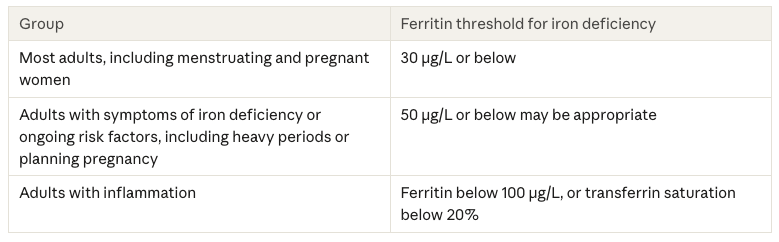
Two points are worth being clear about. First, ng/mL and µg/L are the same measurement, so you can compare US and UK results directly. Second, these are thresholds for diagnosing deficiency, not targets that everyone needs to reach.
What about the UK?
The ASH guidelines are American and haven't been formally adopted in the UK. In some ways, though, UK guidance is already closer to them than many people realise. NICE's guidance for GPs treats a ferritin below 30 µg/L as confirming iron deficiency, and recognises that ferritin up to around 100 µg/L can still hide deficiency when inflammation is present [5]. Some NHS guidance goes further, noting that a ferritin between 30 and 50 µg/L can also be consistent with iron deficiency [6].
The gap is often in what happens in practice:
Laboratory reference ranges vary. Many UK laboratories set the bottom of their "normal" range well below 30 µg/L. One NHS trust's guidance for GPs, for example, uses a ferritin below 11 µg/L in women to confirm iron deficiency anaemia [7]. So a result of 18 or 22 may be reported as normal, even though it sits below NICE's own threshold for iron deficiency.
Iron deficiency without anaemia is easily overlooked. If haemoglobin is normal, low ferritin may not be acted on, and there is no firm UK consensus on treating iron deficiency without anaemia [7].
The higher threshold of 50 µg/L for women with symptoms or heavy periods isn't routinely used.
The practical message is simple: ask for the number, not just whether it was "normal". A ferritin of 14 and a ferritin of 80 can both be described as normal, but they tell a very different story.
Iron deficiency without anaemia: the signs and who is at risk
Symptoms to look out for
Low iron stores can affect how you feel well before haemoglobin drops. Common signs include:
Tiredness that doesn't lift with rest
Brain fog and poor concentration
Increased hair shedding
Breathlessness or a racing heart on exertion, and reduced exercise performance
Restless legs, especially in the evening
Feeling cold, and brittle nails
Low mood and irritability
Unusual cravings, such as for ice
The evidence that correcting low ferritin helps is genuinely encouraging. In a trial of nearly 200 menstruating women with unexplained fatigue, normal haemoglobin and a ferritin below 50 µg/L, 12 weeks of iron supplements reduced fatigue by almost half from where it started, significantly more than a placebo [8]. An earlier trial found that the benefit was only seen in women whose ferritin was below 50 µg/L [9]. Iron isn't a cure-all for tiredness, but if your ferritin is low, it is one of the most treatable causes.
Who is most at risk?
Women with heavy periods, the most common cause of iron deficiency in the UK, including those with fibroids, endometriosis, or the heavier bleeding that often comes with perimenopause.
Women who are pregnant, recently pregnant or breastfeeding.
People eating plant-based diets, as iron from plants is less easily absorbed.
Endurance athletes, who lose iron through sweat, the gut and impact on the feet, and often have higher needs.
People taking weight loss medications such as semaglutide (Wegovy, Ozempic) or tirzepatide (Mounjaro), or who have had weight loss surgery. Eating much less, along with slower stomach emptying, can reduce iron intake and absorption. A 2026 review found iron among the most common deficiencies in people taking these medications [15], a small study found semaglutide reduced iron absorption after ten weeks [16], and most users in one dietary analysis weren't meeting recommended iron intakes [15]. If you're on one of these medications, it's worth having your iron checked, and my weight loss medication support can help you protect your nutrition while you lose weight.
People with gut conditions that affect absorption, such as coeliac disease or inflammatory bowel disease, and those taking long-term acid-suppressing medication.
Regular blood donors.
Always look for the cause
Low ferritin is a sign that iron is being lost or not absorbed, so the reason matters. This is particularly important for men, women who are no longer having periods, and anyone with unexplained iron deficiency, where your GP will want to rule out blood loss from the gut and check for coeliac disease [5].
Why a higher ferritin isn't always good news
Ferritin has a complication: It isn't only an iron store. It is also an "acute phase" protein, which means levels rise with inflammation, infection, liver conditions such as fatty liver disease, heavy alcohol intake and metabolic problems [10]. In fact, fewer than one in ten cases of raised ferritin are due to having too much iron [10].
This matters in two ways.
Inflammation can hide iron deficiency. If you have an inflammatory condition, such as endometriosis, an autoimmune condition or inflammatory bowel disease, ferritin may look normal or even high while your body is still short of usable iron. That is why ASH and NICE both suggest looking at ferritin alongside other markers, such as CRP (a marker of inflammation) and transferrin saturation, when inflammation is present [1, 5].
Too much iron is harmful too. Haemochromatosis, a genetic condition that causes the body to absorb too much iron, is one of the most common inherited conditions in people of northern European, and particularly Irish, descent. Iron can build up silently for years and damage the liver, heart and joints. This is one of the main reasons I always advise testing before taking iron supplements, rather than taking them "just in case". A raised ferritin always deserves a conversation with your GP.
What to do if your ferritin is low
Get the full picture
A useful set of tests includes a full blood count, ferritin and CRP, and ideally transferrin saturation. Avoid testing while you're unwell with an infection, as this can push ferritin up temporarily. And always ask for your actual result.
Food first
There are two types of iron in food. Haem iron, from meat, fish and shellfish, is absorbed far more readily than non-haem iron from plant foods. Both are valuable, and a few simple habits make a real difference:
Include iron-rich foods regularly, such as lean red meat in moderation, sardines, mussels and other shellfish, eggs, lentils, beans, chickpeas, tofu, pumpkin seeds and dark leafy greens
Pair plant sources with vitamin C, from foods such as peppers, citrus fruit, berries or tomatoes, which significantly improves non-haem iron absorption
Keep tea and coffee away from meals, ideally by an hour or so, as they reduce iron absorption
Separate calcium supplements from iron-rich meals
Diet alone can maintain healthy iron levels for many women, but once ferritin is genuinely low, food may not be enough to rebuild stores in a reasonable time, especially if periods are heavy.
Supplements, done well
If supplements are needed, the form you take and how you take it matter just as much as the dose:
Never guess. Always know your ferritin and iron status before taking an iron supplement. Too much iron is harmful, particularly for people with haemochromatosis, and iron isn't a supplement to take "just in case".
The form matters. The iron most commonly prescribed in the UK, ferrous sulfate, works for many people, but standard doses are high and only a small fraction of each dose is absorbed. The iron that isn't absorbed stays in the gut, where it commonly causes constipation, nausea, stomach pain and other digestive upset. A large review found that ferrous sulfate more than doubles the risk of digestive side effects compared with a placebo [13], and many women stop taking it as a result.
Gentler forms are available. Iron bisglycinate, a form of iron bound to an amino acid, is generally much kinder to the gut. A review of 17 trials found it improved iron status at least as well as other forms, with fewer digestive side effects, particularly in pregnancy [14]. Other gentler options, such as liposomal or sucrosomial iron and haem iron, are also available, although the research on these is more limited.
Consider alternate days. Each dose of iron triggers a rise in hepcidin, a hormone that reduces absorption for around 24 hours. Research shows that taking iron as a single morning dose on alternate days leads to better absorption than daily or split doses, and often fewer side effects [11, 12].
Take it with vitamin C, away from tea, coffee and calcium. If it upsets your stomach, taking it with food is better tolerated, although slightly less is absorbed [5].
Keep going for long enough. Ferritin rises slowly. A recheck after about two to three months shows whether it's working, and NHS guidance is to continue for around three months after levels normalise to rebuild stores [5].
If your ferritin isn't going up, find out why. It may be the form of iron, how well your gut is absorbing it (for example because of coeliac disease, low stomach acid, acid-suppressing medication or inflammation), ongoing losses, or something else entirely. This is where working with a nutritional therapist can really help. In my experience, different forms of iron work very differently for different people and different guts, and finding the right one often makes all the difference.
Normal isn't the same as optimal for you
My key point to highlight: A ferritin result described as "normal" may still be low enough to affect how you feel, so it's always worth knowing your number. The new ASH guidance is a welcome recognition of something many women, and the practitioners who support them, have suspected for a long time.
Low iron is one of the most common, and most fixable, reasons women feel exhausted. Getting the right tests, understanding the results, and correcting low stores thoughtfully can make a real difference.
Want support with your iron levels?
If you'd like help making sense of your blood results and building a plan that works for you, please book in for an enquiry call with me to discuss things. You can book a session with me here.
And if you'd like more articles like this one, grounded in the science without the overwhelm, my free newsletter goes out every fortnight.
References and further reading
American Society of Hematology. ASH sets new standards for diagnosing iron deficiency. September 2026.
Medscape. Iron deficiency, diagnosis: ASH 2026 guideline summary. 2026.
Comparison of current World Health Organization guidelines with physiologically based serum ferritin thresholds for iron deficiency in healthy young children and nonpregnant women using data from the Third National Health and Nutrition Examination Survey. 2023.
Addo Y, et al. Physiologically based serum ferritin thresholds for iron deficiency among women and children from Africa, Asia, Europe, and central America: a multinational comparative study. Lancet Glob Health. 2025;13:e831–e842.
NICE Clinical Knowledge Summaries. Anaemia – iron deficiency. Revised 2024.
NHS Highland. Iron deficiency guidelines.
Royal United Hospitals Bath NHS Foundation Trust. Ferritin: a guide for GPs.
Vaucher P, Druais PL, Waldvogel S, Favrat B. Effect of iron supplementation on fatigue in nonanemic menstruating women with low ferritin: a randomized controlled trial. CMAJ. 2012;184(11):1247–1254.
Verdon F, et al. Iron supplementation for unexplained fatigue in non-anaemic women: double blind randomised placebo controlled trial. BMJ. 2003;326:1124. Summary.
Updating the diagnosis and management of elevated serum ferritin levels in the era of routine ferritin testing of blood donors by Australian Red Cross Lifeblood. 2025.
Stoffel NU, Cercamondi CI, Brittenham G, et al. Iron absorption from oral iron supplements given on consecutive versus alternate days and as single morning doses versus twice-daily split dosing in iron-depleted women: two open-label, randomised controlled trials. Lancet Haematol. 2017.
Stoffel NU, Zeder C, Brittenham GM, et al. Iron absorption from supplements is greater with alternate day than with consecutive day dosing in iron-deficient anemic women. Haematologica. 2020.
Tolkien Z, Stecher L, Mander AP, Pereira DIA, Powell JJ. Ferrous sulfate supplementation causes significant gastrointestinal side-effects in adults: a systematic review and meta-analysis. PLoS One. 2015;10(2):e0117383.
Fischer JAJ, et al. The effects of oral ferrous bisglycinate supplementation on hemoglobin and ferritin concentrations in adults and children: a systematic review and meta-analysis of randomized controlled trials. Nutr Rev. 2023.
Urbina J et al. Micronutrient and nutritional deficiencies associated with GLP-1 receptor agonist therapy: a narrative review. Clin Obes 2026.
Melis P, Lucijanic M, Kranjcec B, Cigrovski Berkovic M, Marusic S. The effect of semaglutide on intestinal iron absorption in patients with type 2 diabetes mellitus: a pilot study. Diabetes Obes Metab. 2025;27(6):3542–3545.